Safe From The Storm
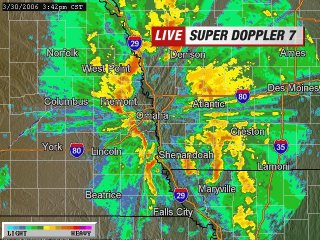
This is what the storm looked like on radar as it was bearing down on the heart of Omaha Thursday afternoon.
Wednesday, we warned the girls that the National Weather Service would be testing the tornado sirens twice as part of "Severe Weather Awarness Day." The first test would occur at 10:10 a.m., while they were in class. The second would happen at 6:45 p.m., in hopes that families would practice their emergency routines.
Dad asked Lauren who in her class would be most afraid during the drill. He told her to whisper to whomever that was that "the tornado probably is destroying a lot of houses, but probably not yours - or the school." But Lauren told Dad she would be the one most likely to be frightened during the drill.
So what do you know... the next day, the sirens go off - and this time it is not a drill. The girls were out delivering Red Wheel fundraising food items - headed toward Envoy, when the sirens began sounding to indicate a tornado warning.
They hustled home and went straight to the basement. "We could still play, though," Lauren says.
Meantime, Dad was actually sweating it out himself when someone in the office heard reports on the TV that a tornado was on the ground just about a mile away from Envoy. He immediately grabbed his portable radio (thanks, Grandma YD) and hustled into a first floor stairwell. Eventually, nearly two dozen people - some from a nearby restaurant - gathered amongst paper dumpsters and supplies beneath the stairs, listening intently to the radio reports.
It turns out the tornado report near Envoy was an erroneous one. But it still had Dad a little concerned. He's always been out chasing the storms or watching their movement on radar. Now he was reduced to being "blind" and cramped in with a bunch of people who kept asking him what was happening.
posted by Unknown at
6:58 AM


4 Comments:
Don't forget about the southwest corner of the basement!
4:34 AM
Wrong.
"Myth or Misconception #1 .... The southwest corner of a basement is the safest location during passage of a tornado.
The truth is that the part of the home towards the approaching tornado (often, but not always, the southwest) is the least safe part of the basement, not the safest. This is also true of the above-ground portion of the house. In most tornadoes, many more homes will be shifted than will be blown completely free of a foundation. Homes that are attacked from the southwest tend to shift to the northeast. The unsupported part of the house may then collapse into the basement or pull over part of the foundation, or both. Historically, the few deaths in basements have been caused by collapsed basement walls, houses, and chimneys, rather than by debris that was thrown into the basement from the outside.
For nearly a century, the published conventional wisdom was that the southwest corner of a building, both above and below ground, afforded the best protection. This misconception probably originated from someone's reasoning, rather than from actual observations. They probably assumed that deadly debris would be propelled over the southwest corner and land in the northeast corner.
The idea that it was safe to seek shelter on the side of a house facing the oncoming tornado dates back to at least the first book on tornadoes, the 1887 comprehensive text Tornadoes, by John Park Finley. He placed in italic for emphasis the following remark: "Under no circumstances, whether in a building or in a cellar, ever take a position in a northeast room, in a northeast corner, or an east room, or against an east wall." He also recommended removing the furniture from the west-facing room and closing all windows in the house. This is all incorrect, deadly, and time-wasting advice. It is quite possible that someone has died following it. While relatively few people probably read the book when it was available, the advice was quoted in many newspapers. It is possible that in the limited number of damage surveys that Finley conducted personally, he came upon a grisly scene involving the northeast portion of a poorly constructed house that had fallen over, and it strongly influenced his thinking.
These assumptions went essentially unchallenged until 1966, when Professor Joseph Eagleman of the University of Kansas undertook a survey of destroyed produced by after the Topeka tornado of June 8th. Professor Eagleman's objective study showed that the south side and southwest corners, the direction of approach for the Topeka tornado, were the least safe areas, and the north side of homes were the safest .... both on the first floor and in the basement. He repeated the study after the Lubbock, Texas tornado of May 11, 1970, and the results were even more striking. The southwest portion of the houses were unsafe in 75% of the damaged homes .... double the percentage of unsafe areas in the northeast part of homes. As a general rule, people in basements will escape injury despite the extreme devastation above them. Being under a stairwell, heavy table, or work bench will afford even more protection.
Ignorance of this conventional wisdom, combined with common sense, has saved lives in the past. At the Pacolet Mills near Gainesville, Georgia on June 1, 1903, 550 people ran to the northeast corner of the building as the tornado approached from the southwest. That northeast corner was the only part of the building not destroyed. At least fifty people died in other Gainesville fabric mills on that day, and more than 40 more died in homes near the mills."
4:40 AM
Very interesting stuff.
6:39 AM
I wonder if that's why most trailer parks seem to be in the southwest part of town.
8:00 AM
Post a Comment
Subscribe to Post Comments [Atom]
<< Home